All Categories
Featured
Many believe performance will be the brand-new frontier.
And open-source thinking designs and representatives will keep pushing limits to conquer enterprise AI. At the same time, trust and security will become essential priorities as lots of business sharpen their concentrate on AI sovereignty. That's just the opening act for what's to come in business tech in the days ahead.
AI is moving from experiments to systems. For much of the past years, AI has resided in a familiar pattern: promising pilots, excellent demos, and separated wins that hinted at improvement however seldom reshaped core systems. By 2026, that pattern might break. Here's what tech leaders require to understand about scaling AI successfully in 2026.
New Role of AI On GCC Growth
AI Trends for 2026: What Tech Leaders Need to Know 2.1 2.3 Multimodal AI Becomes the Default User Interface 2.5 Domain-Specific Models Overtake General-Purpose AI 2.6 Generative AI Progresses Beyond Material Production 2.9 AI Governance, Security, and Data Trust Become Non-Negotiable 2.10 Operationalizing AI: From Pilots to ROI For much of the previous decade, AI has actually resided in a familiar pattern: appealing pilots, excellent demonstrations, and isolated wins that hinted at transformation however seldom improved core systems.
The shift is subtle however substantial: AI is becoming a core infrastructure, not an add-on. Together, these shifts define the leading AI patterns in 2026, marking a clear relocation from speculative tools to operationally embedded systems.
For technology leaders, this minute feels various from previous AI buzz cycles. Earlier stages focused on capability: could designs create text, recognize images, or forecast results? In 2026, the focus will move to combination: how AI systems communicate with existing platforms, how they scale dependably, how they are governed, and how they deliver quantifiable worth under real-world restraints.
Rather of functioning as a reactive tool that awaits prompts, AI is significantly created to function as a partner, one that can interpret objectives, coordinate jobs, and run across systems with a degree of autonomy. This shift has architectural implications as much as organizational ones, requiring brand-new techniques to software style, information management, and system orchestration.
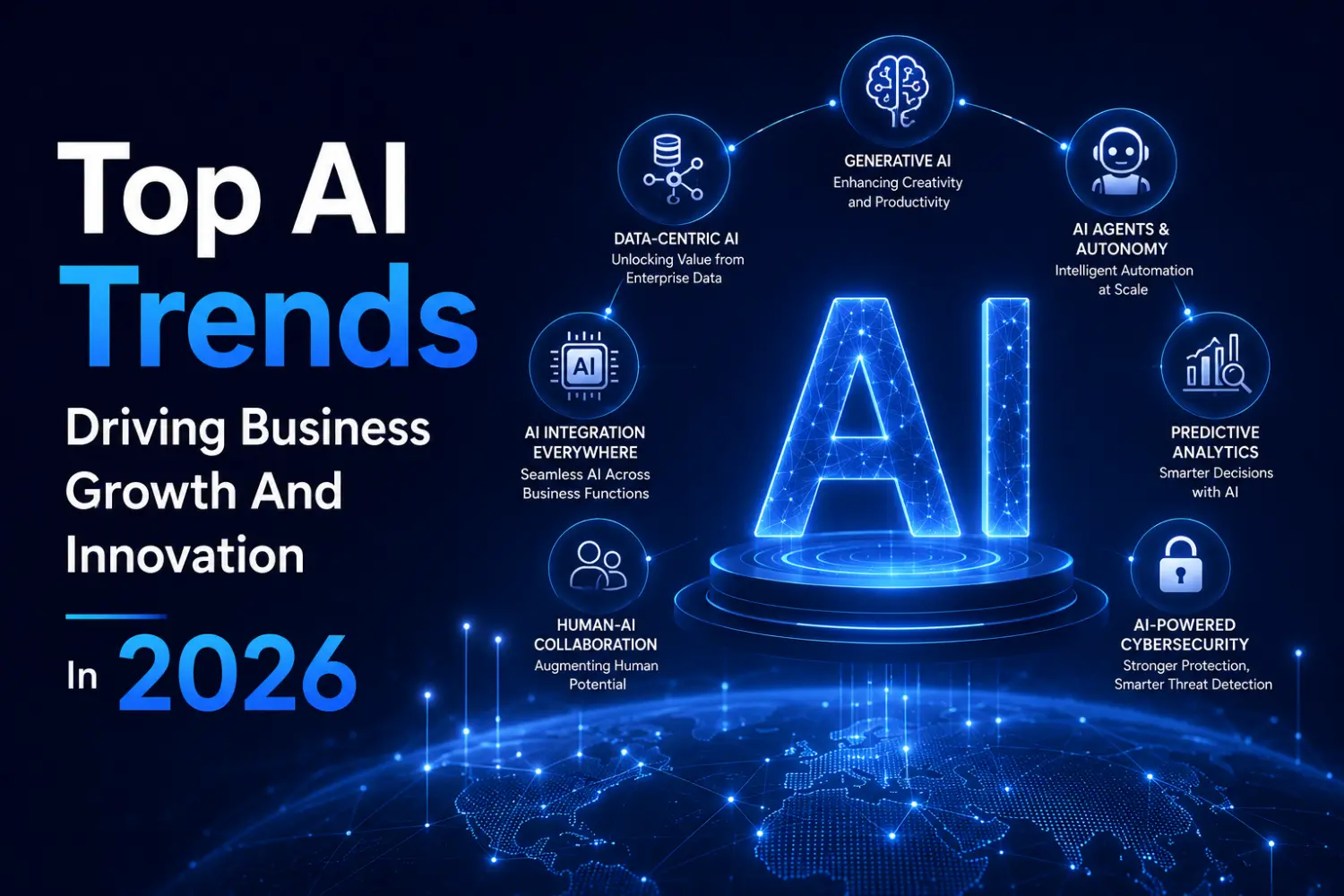
They will be less about novelty and more about what AI can provide in practice. Comprehending the top AI trends in 2026 requires looking beyond private designs and concentrating on how AI is engineered into genuine systems. Listed below, let's take a look at what the leading AI trends in 2026 are. For many companies, AI's public advancement was available in the type of conversational user interfaces.
Reviewing AI Tools to Watch in 2026
Agentic AI refers to systems developed around goals rather than prompts. The shift is subtle in idea however heavy in execution: AI is no longer just responding to users; it is starting to run within systems.
Where earlier AI combinations focused on enhancing private features: search, recommendations, material generation, genetic systems crossed workflows. They connect data sources, coordinate tasks, and operate asynchronously across time and services. In practice, this suggests AI is coming closer to the function of an orchestrator than a function. Early agentic tools frequently depend on a single, general-purpose representative charged with doing "a little everything." That approach is now showing its limits.
Is Your Riyadh Business Ready for the Open Banking Era?The emerging pattern in 2026 is multi-agent orchestration: systems made up of specialized representatives, each responsible for a discrete function, coordinated by a higher-level controller. This mirrors established software architecture principles, where dispersed services replaced monoliths to enhance strength and scalability. For technology leaders, the ramification is clear: agentic AI is less about individual models and more about system design.
These are not simply AI obstacles; they are software application engineering obstacles, magnified by autonomy. Lots of engineers describe the existing phase of agentic AI as its "microservices moment." The example is instructional. Simply as microservices introduced versatility at the cost of increased architectural intricacy, agentic systems promise higher levels of automation while demanding stronger foundations.

Latest Posts
Why Advanced AI Is Crucial for 2026 Growth
Implementing Advanced AI to Scale Digital Roadmaps
The Role of AI in 2026 Market Growth